
Overview#
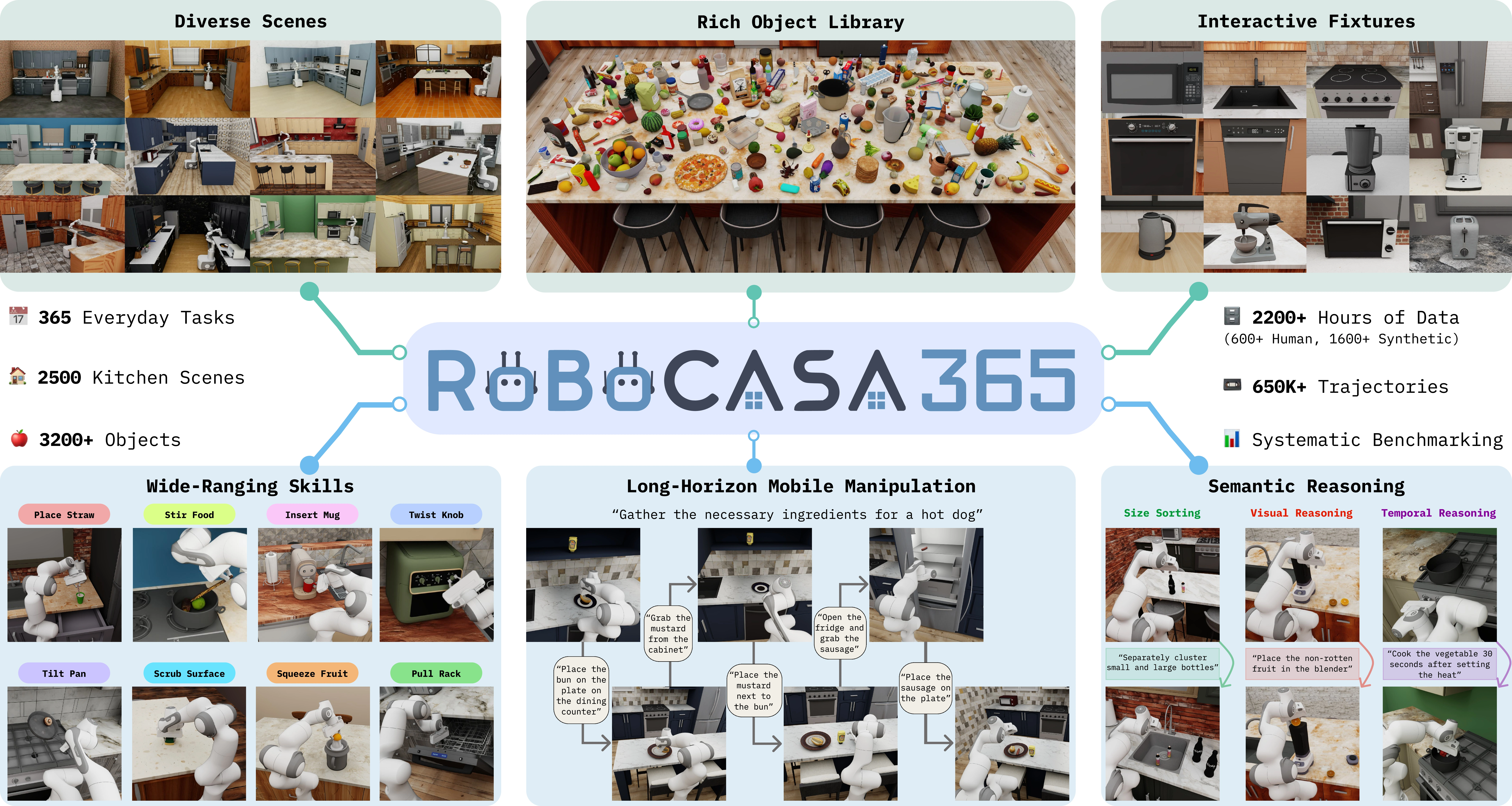
RoboCasa is a large-scale simulation framework for training generally capable robots to perform everyday tasks. It was originally released in 2024 by UT Austin researchers. The latest iteration, RoboCasa365, builds upon the original release with significant new functionalities to support large-scale training and benchmarking in sim. Four pillars underlie RoboCasa365:
Diverse tasks: 365 tasks created with the guidance of large language models
Diverse assets: including 2,500+ kitchen scenes and 3,200+ 3D objects
High-quality demonstrations: including 600+ hours of human demonstrations in addition to 1,600+ hours of robot datasets created with automated trajectory tools
Benchmarking support: popular policy learning methods including Diffusion Policy, pi, and GR00T, plus user-submitted models on the leaderboard
This documentation guide contains information about installation, getting started, and additional use cases such as accessing datasets, policy learning, and API docs.
Citation#
RoboCasa365:
@inproceedings{robocasa365,
  title={RoboCasa365: A Large-Scale Simulation Framework for Training and Benchmarking Generalist Robots},
  author={Soroush Nasiriany and Sepehr Nasiriany and Abhiram Maddukuri and Yuke Zhu},
  booktitle={International Conference on Learning Representations (ICLR)},
  year={2026}
}
RoboCasa (Original Release):
@inproceedings{robocasa2024,
  title={RoboCasa: Large-Scale Simulation of Everyday Tasks for Generalist Robots},
  author={Soroush Nasiriany and Abhiram Maddukuri and Lance Zhang and Adeet Parikh and Aaron Lo and Abhishek Joshi and Ajay Mandlekar and Yuke Zhu},
  booktitle={Robotics: Science and Systems (RSS)},
  year={2024}
}